Every new managed service you want to offer, whether it’s a firewall upgrade, better QoS, Business Ethernet or a voice package, traditionally means a truck roll, a hardware swap, or months of integration work before a customer can start using it. Ekinops OneOS Built-in Services flips that as all capabilities are already present in the OneOS6 devices your customers run, and you activate them remotely, on demand, through a software license. What used to be a deployment project becomes a service you can turn on the same day a customer asks for it.
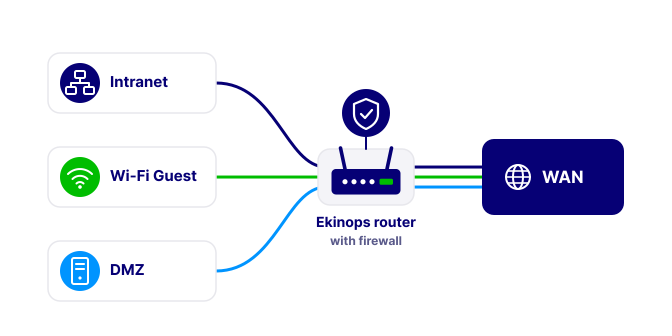
No physical access needed. Once a device is deployed and connected, new capabilities are enabled by applying a software license remotely, through your management platform, without a technician visiting the site.
Yes. The same software runs across our physical access routers and virtualized deployments, so configurations, operational knowledge, and licensing carry over regardless of which form factor your customer runs.
It’s designed for a smooth migration from OneOS5, with simultaneous support for NETCONF, CLI, and TR-069, so you can move customers to modern orchestration at your own pace rather than in one disruptive cutover.
It depends on the router model and license. Voice and eSBC functions are available on dedicated access router models, activated through a software license rather than separate voice hardware.
Virtual Routing and Forwarding (VRF) lets a single device run several completely separate routing tables at once. In practice, that means you can host multiple customers, or multiple departments, on the same physical router without their traffic ever mixing or one seeing the other’s network.
Applications Identification and Control (TIC) identifies which application is generating traffic in real time, so the device can automatically prioritize something like a voice call or video conference over routine web browsing, without your team manually configuring rules for every application.
Command-line configuration works fine for a handful of devices but doesn’t scale to hundreds or thousands. NETCONF/YANG let orchestration software configure many devices consistently and automatically, which is what makes it practical to manage a large fleet without a proportionally large operations team.
Standard orchestration platforms. The platform is built on industry-standard interfaces, including NETCONF/YANG, rather than a closed, proprietary command set, so it integrates with third-party orchestrators instead of requiring our own tooling exclusively.