The most adaptable Layer 1 optical transport system in the industry

The Telco Standard Platform combines active and passive DWDM and CWDM solutions for metro, long-haul and submarine transport applications.
USE CASES

Why implement the Telco Standard Platform?

Traditional optical transport networks often mean separate systems for line transport, amplification, and wavelength routing, each with its own footprint, power draw, and upgrade cycle. Ekinops Telco Standard Platform consolidates transponders, muxponders, amplifiers, and ROADMs into a single chassis, avoiding the forklift hardware replacements that come with most transport platform generations.

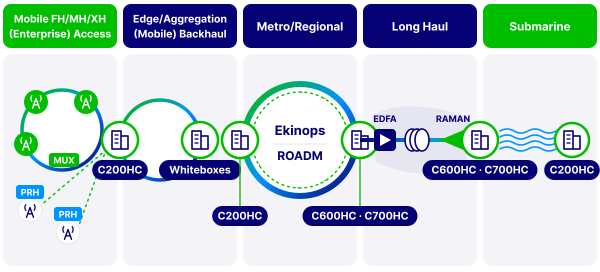
  • Metro to Submarine Networks

    Standardize one vendor and one architecture as your network grows from a metro ring into long-haul or submarine territory, instead of requalifying a new platform for each distance.
  • Operators Scaling Existing Fiber

    Add wavelengths and capacity as traffic grows, on the same chassis, without doing a rip and replace or add a parallel system.
  • Automated Service Activation

    Provision of new optical services end to end from the network control center, without manual configuration at each site.
FEATURES

What's behind the platform

From 100G to 800G per wavelength

  • The same chassis accommodates everything from low-speed client access modules to the highest-capacity coherent transport cards, covering line rates from 1G to 800G without a technology break.
  • Proprietary coherent optical technology, designed in-house rather than built to a generic industry module standard, reaching exceptional distances without intermediate amplification.
  • Powered by FlexRate™ technology, dynamically adjusts modulation format and error correction to deliver programmable speeds from 100G to 800G per wavelength on its coherent cards, adapting automatically to distance and fiber conditions, terrestrial or submarine, up to 10,000 km.
  • Transmits bidirectionally on a single fiber strand at speeds up to 600G, effectively doubling capacity on fiber routes that are already full.
  • Aggregates multiple protocols directly onto existing OTN network cores for maximum spectral efficiency.
Front view of Ekinops’ Telco Standard Platform with modular optical line terminal cards and fiber optic connectivity ports.
RESSOURCES

Go further

FAQ

Find your answer to common questions on Ekinops Telco Standard Platform.

FlexRate™ is Ekinops’ programmable coherent optics technology. Instead of a fixed speed per card, it dynamically adjusts the modulation format and error correction to deliver the best possible speed, from 100G to 800G per wavelength, for the specific distance and fiber conditions of your link.

Yes. The same chassis and card architecture cover metro, regional, long-haul, and submarine applications, so a network built for metro today can extend to longer routes later using the same platform family rather than a different one.

Yes. An offline simulation tool built into the management suite pulls real configuration and performance data from your live network to model the impact of a change, such as adding new wavelengths, and calculate the right parameters before anything is deployed, without disrupting live traffic.

Often, yes, through Alien Wavelength support. Ekinops coherent channels can be injected directly onto many existing third-party optical line systems, adding capacity without replacing your existing filtering or routing infrastructure.

Yes. It shares the same Celestis NMS management suite and card architecture as Ekinops other optical platforms, including the compact modular platform built for data center, so you can manage a mixed deployment from one console.

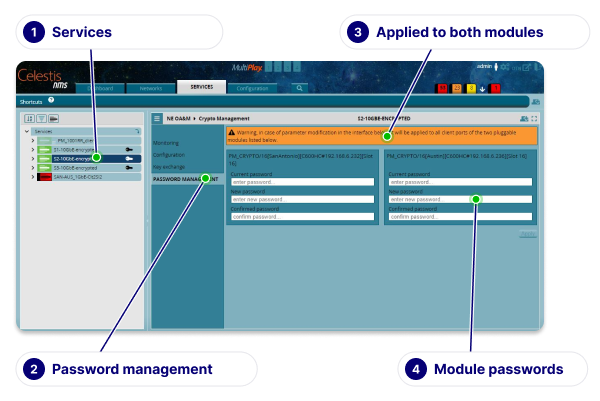
Yes. Celestis NMS connects to the optical nodes via SNMP and exposes an open Northbound Interface (NBI) supporting REST/JSON and SNMPv2c/SNMPv3 APIs, so you can integrate optical alarms and provisioning workflows into your own orchestrators or existing operations and billing platforms, rather than being limited to Celestis NMS as a standalone tool.


LET'S TALK

Ready to scale your optical network without a rip-and-replace?